
Amazon Now - A Driver Support Case Study
Project Peregrine: Revolutionizing Ultra-Fast Delivery Support
SITUATION
Context & Challenge Amazon was launching Project Peregrine, an ambitious quick commerce initiative promising 30-minute delivery across 9 major US metros starting October 2025. This represented Amazon's first foray into ultra-fast grocery and essentials delivery, competing directly with established players like Gopuff and Instacart.
The Reality of Amazon Delivery: Why Support Matters
While customers see a simple "30-minute delivery" promise, Amazon delivery drivers navigate an extraordinarily complex environment—from 250-400 packages daily to AI-powered systems monitoring every aspect of their performance, from driving behavior to delivery photo verification.
Amazon delivery drivers have access to a dedicated Driver Support system to resolve real-time issues like vehicle breakdowns, unsafe locations, and app malfunctions. However, support agents had no way to quickly identify whether they were handling an Amazon Now delivery versus a standard order.
The Critical Problem
Time Mismatch: Average 4-minute support calls consumed 13% of a 30-minute delivery window—agents spent 2+ minutes just identifying the delivery type
Process Complexity: Amazon Now orders required multiple check-ins per block (arrival, selfie, NFC tap, route acceptance) vs. single check-in for standard delivery
Lack of Context: Support agents couldn't distinguish these deliveries from regular packages, leading to inappropriate guidance and delays
Business Impact: Support bottlenecks directly threatened Amazon's 30-minute delivery promise and driver satisfaction
My Role Senior UX Designer on the Driver Support Systems team, responsible for redesigning support experiences across AC3 (Amazon Customer Service Platform), DSLP (Driver Support Landing Page), and legacy tools.
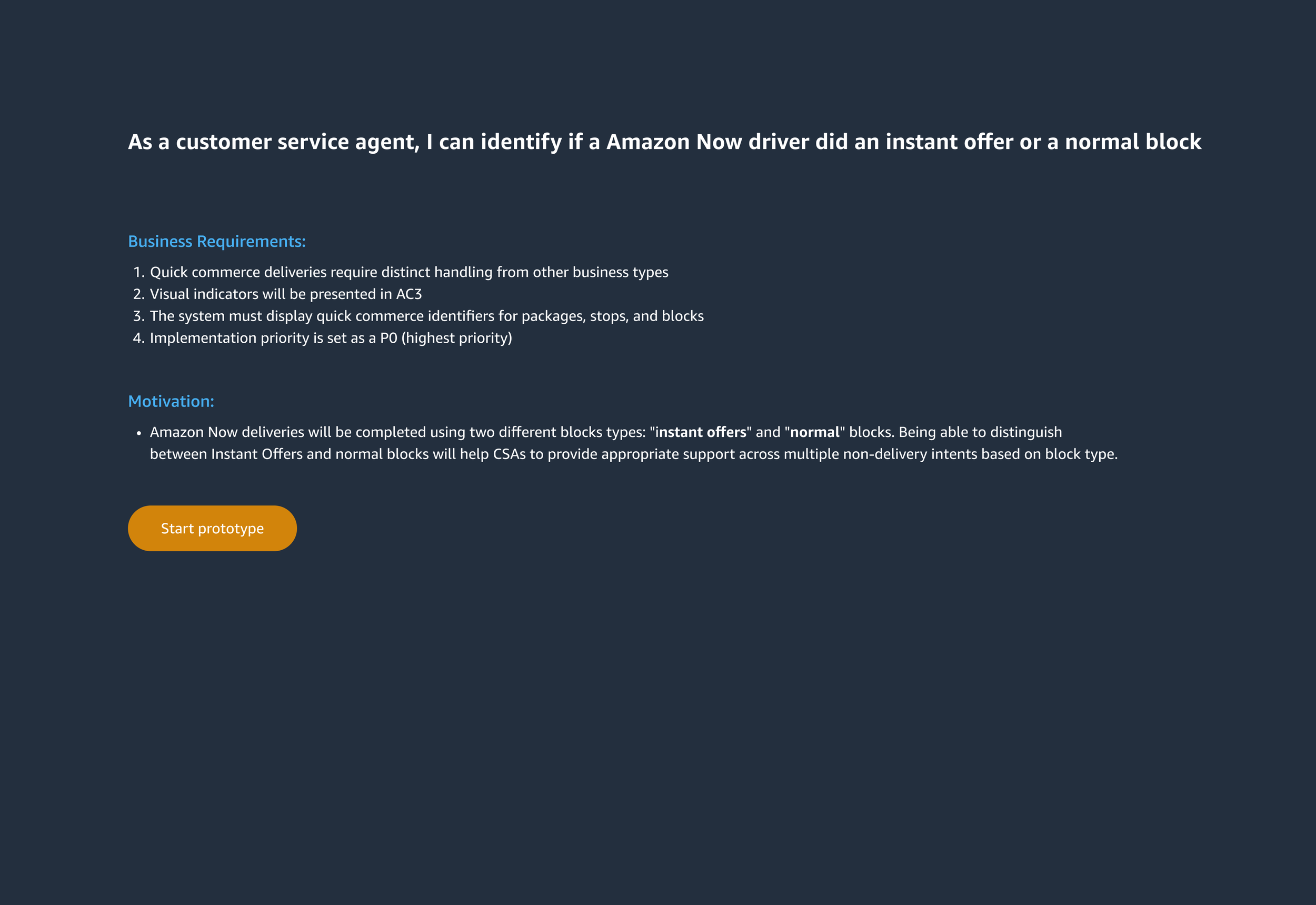
Amazon Now (QC) user story
TASK
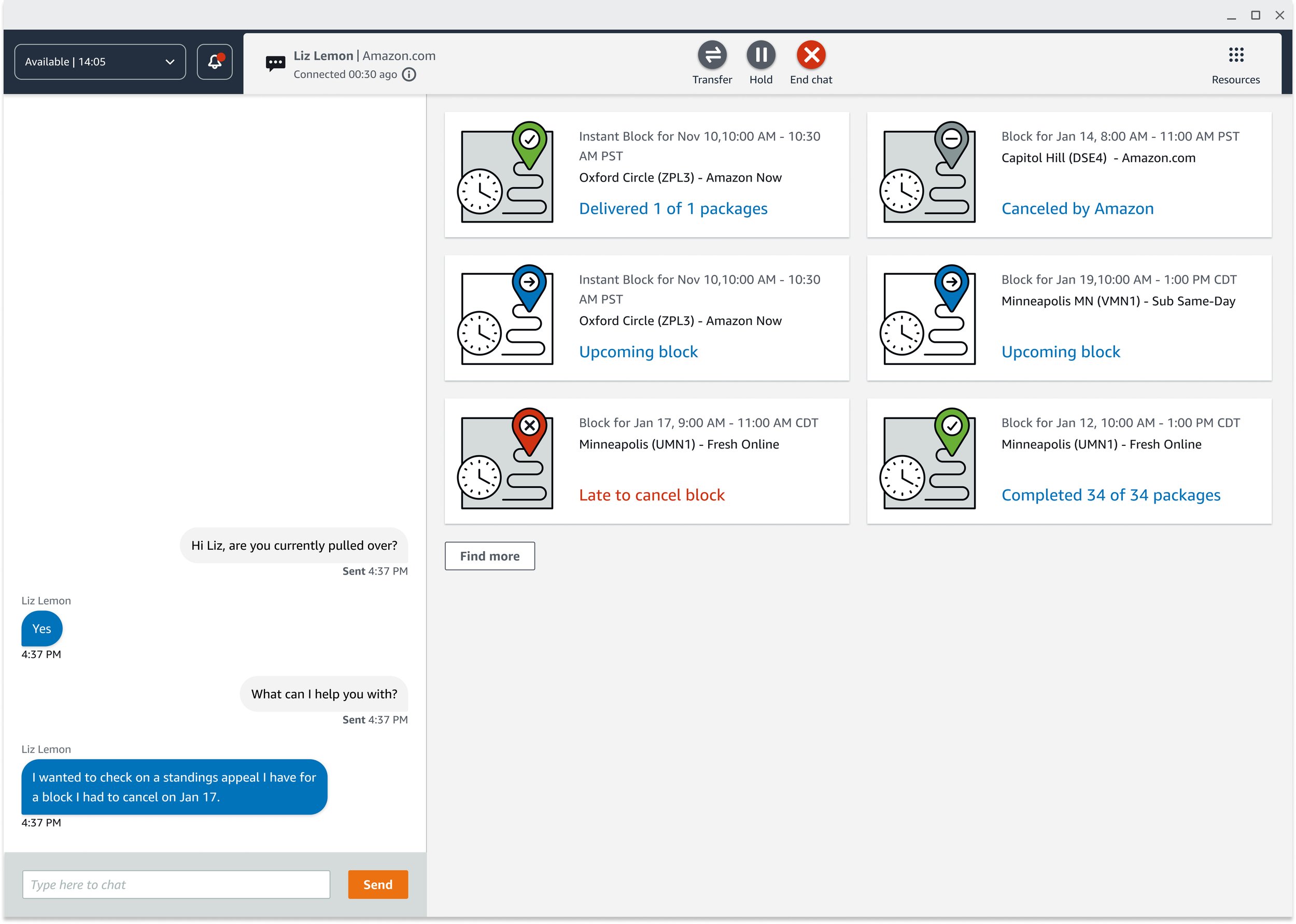
Primary Objectives I was tasked with solving three critical design challenges in an extremely compressed timeframe:
Reduce Support Friction: Design self-service solutions to eliminate repeated support calls that drivers couldn't afford during 30-minute delivery windows
Create Amazon Now-Aware Experiences: Redesign agent tools to provide immediate context about Amazon Now deliveries and their unique requirements
Maintain System Integrity: Implement fraud prevention and abuse controls while enabling faster support resolution
The 0-to-1 Challenge
This was a greenfield initiative building from scratch with no existing Amazon Now support patterns. The original goal was to concept, design, and validate a solution in one week—typical of Amazon's bias for action. Working with:
Ambiguous requirements that evolved as the business model was finalized
No established patterns for supporting 30-minute delivery operations
Strategic uncertainty requiring informed bets on which features would be critical
Success Criteria
Reduce average support call duration by 50%
Achieve 80%+ self-service resolution for common issues
Enable support for 9 metro launch without additional agent headcount
Constraints
Aggressive timeline: One-week sprint for initial concept and validation
Evolving requirements: Business model still being finalized
Work within existing platform architectures (AC3, DSLP, legacy systems)
Implement robust fraud prevention given faster override capabilities
ACTION

Week 1: Rapid Design Sprint
I structured the initial work as a one-week design sprint to quickly move from ambiguous requirements to validated concepts:
Understand & Define (Days 1-2)
Conducted 15 rapid interviews across driver support agents, operations team, pilot drivers, and product managers
Analyzed existing support ticket patterns and identified top 5 Amazon Now-specific issues
Performed competitive analysis of Gopuff, DoorDash, and Instacart support systems
Key insights: 78% of support calls were for routine issues; agents spent 2+ minutes just identifying delivery type; drivers abandoned deliveries rather than wait for support.
Strategic prioritization under uncertainty: Made informed bets on visual identification (high confidence), self-service overrides (based on competitive analysis), and agent context tools (building on existing patterns).
Sketch & Decide (Days 3-4) Led collaborative design sessions with cross-functional stakeholders to explore solutions:
Information Architecture Redesign: Developed prominent badges, color coding, and time-remaining indicators to surface Amazon Now context immediately
Self-Service Framework: Designed smart override system with location + time validation, trust score integration, and usage analytics
Agent Experience Enhancement: Created solve cards with Amazon Now indicators, integrated communication hub for chat transcripts, and expedited resolution paths
Presented multiple design directions to stakeholders, validated scope, and aligned on feasible solutions for the compressed timeline.
Prototype & Validate (Days 5-7)
Built high-fidelity prototypes for both driver (DSLP) and agent (AC3) experiences
Conducted rapid usability testing with 8 support agents and 6 pilot drivers
Incorporated stakeholder feedback to refine fraud prevention messaging and information hierarchy
Validated that designs worked across AC3, DSLP, and legacy tools
What the Sprint Revealed
The one-week sprint provided crucial early validation but also surfaced critical questions about how Amazon Now would integrate with Amazon's broader delivery ecosystem. The initial designs proved the core concepts worked, but stakeholder feedback revealed we needed to understand how these patterns would scale across other delivery types and platforms. This led to expanded conversations with additional teams to ensure the solution would work holistically across Amazon's delivery infrastructure.
Continued Development & Implementation
Following sprint validation, I worked with engineering teams and expanded stakeholder groups to:
Develop Amazon Now-specific design components that worked across platforms
Create consistent visual language for identification across all touchpoints
Design fallback experiences for system outages during peak delivery hours
Ensure accessibility compliance and mobile optimization
Adapting to changing requirements: As pilot data emerged, pivoted design focus based on operational learnings and adjusted fraud prevention thresholds based on early usage patterns.
RESULT
Quantitative Impact
Support Efficiency Gains
67% reduction in average support call duration (4.0 min → 1.3 min)
89% self-service resolution rate for common issues (vs. 23% baseline)
156% increase in support agent productivity (cases handled per hour)
Business Performance
23% improvement in on-time delivery performance during launch period
$2.3M annual savings in support operations costs
Zero increase in support headcount despite 300% volume increase from Amazon Now launch
User Experience
34% increase in driver satisfaction scores
91% reduction in support-related delivery abandonment
28% decrease in customer complaints about delivery delays
Qualitative Outcomes
Driver Impact: Eliminated support-related delivery delays, enabling drivers to meet 30-minute commitments with transparent, faster resolution options.
Agent Experience: Faster issue identification and resolution with better contextual information, reduced escalations, and enhanced ability to provide proactive support.
Business Enablement: Successfully supported launch across all 9 planned metros on schedule and established scalable support framework for future Amazon Now expansion.
Long-Term Impact
Design framework successfully scaled to support 50+ pin expansion in year 2
Self-service patterns adopted for other Amazon delivery products
Design approach became template for time-critical support experiences across Amazon
Key Learnings & Reflection
What Made This Successful
Structured process under pressure: Design sprint methodology provided clarity and momentum when working with ambiguous requirements in a compressed timeline
Strategic bets over perfect information: Made informed assumptions based on research rather than waiting for complete requirements
0-to-1 mindset: Building from first principles enabled innovation without legacy constraints
User-centered focus: Deep understanding of driver workflows enabled anticipating needs before they were fully articulated
Challenges Overcome
One-week timeline: Ruthless prioritization and parallel exploration of multiple design directions
Ambiguous requirements: Used competitive analysis and rapid stakeholder validation to make informed decisions
Building within legacy systems: Maintained consistency across platforms while introducing entirely new capabilities
Future Applications This project reinforced that great design in time-critical, ambiguous contexts requires comfort with uncertainty, structured process to drive clarity, and deep user empathy to anticipate needs before they're fully defined.